Case Study: Rebuilding a Fine Arts Applicant for Carnegie Mellon
by Hoon Kim, CEO and College Consulting Lead
About 50% of the time, students who come to seek my services as a college admissions consultant can be broadly categorized as a “gap” student. To be sure, they are studious, ambitious, and have tremendous potential to be highly successful in life. But for various reasons or another, have glaring gaps in their resume.
This can be academic, taking only lower-level courses without showing a penchant for rigor. Or community-based, where there is virtually zero commitment to serving the community. Or their college entrance exam stands starkly in contrast to their GPA. Or just a terrible set of essays. Or in any number of areas that are important to judge an adolescent’s character, values, and intellect.
And depending on their grade, this can either be a solvable concern or a real-life crisis.
I think sharing a real-life mini-case study here will help shine a light on how one individual was able to overcome this gap and what the role of a college consultant can be.
After being rejected from Carnegie Mellon’s College of Fine Arts, Mel worked with us at Pittsburgh Prep to create a strategically structured gap year to rebuild his portfolio, deepen his artistic identity, and transform a misaligned application into an Early Decision acceptance.
Mel* came to me through a cold inquiry, which almost never happens. Nearly all of my families are referred by someone I already know, so I remember being slightly surprised when I found myself on the phone with his father for close to an hour that afternoon. By the time we hung up, I understood why he had reached out.
Mel had applied to one school the previous year. Only one: Carnegie Mellon’s prestigious College of Fine Arts. He was roundly rejected. When I reviewed his application and essays, it became clear why.
His grades were solid. Not exceptional, but respectable. The larger issue was alignment. Being a member of the art club or film club is perfectly fine, but those activities alone do not establish someone as a serious, developing artist. The application lacked cohesion. The essays did not reflect a young artist with conviction or direction. Instead, they read like someone still searching for footing, unsure of where he was headed. There was ability there, but no clear narrative thread tying his experiences together.
We spent considerable time unpacking that problem. His original essays were written in a tone that was reactive and scattered, moving from one experience to another without clarity about who he was as an artist or what questions his work was trying to answer. Over the course of the gap year, we rebuilt those essays alongside the portfolio. Instead of writing about activities, we began writing about inquiry. Instead of describing what he had done, we articulated what he was investigating through his art and why it mattered. By the end, the essays reflected a coherent artistic identity that aligned directly with the work in his portfolio and the direction he intended to pursue.
Now he was taking a gap year, and the family wanted to know whether applying again to CMU was realistic.
As his father filled in more of the background, the complexity surfaced. A middle school transition. Bullying. A period of withdrawal and slipping grades. Multiple high school changes before things stabilized. By graduation, Mel had regained academic balance and was producing competent work, but the earlier instability had shaped both his confidence and his application choices. Applying to only CMU had been a gamble. The rejection forced a reset.
It was complicated, but I thrive when a situation is layered, messy, and high stakes. These are the students who require more than editing and deadline management. They require strategy, rebuilding, and honest conversations.
Before we made any moves, I wanted direct insight from the source. I took the initiative to schedule meetings with the head of the fine arts program and with a senior CMU professor. These were substantive discussions about what the faculty had been seeing in recent applicant pools and what they were hoping to see more of.
Two important clarification insights emerged immediately: Over the past decade, CMU had actually enrolled very few students from Pittsburgh, and there was now a conscious desire to increase local representation. Also, CMU was looking for student artists who were “unafraid to tackle the hard questions” in society. Students who are active, make impact with their art, and build community.
They also explained that many high school portfolios tend to focus heavily on stylized or cartoon based work, which is understandable at that age but often limited in scope. What they were looking for was greater artistic maturity in subject matter and execution, including work in portraiture, sculpture, and multimedia that demonstrated sustained inquiry and intellectual depth.
When I compared that description to Mel’s existing portfolio, the gap was obvious. We needed to do more than just “tweak” a few pieces; instead, we had to rebuild his entire body of work in a serious way.
The first step was immersion in a professional environment. I helped secure him an internship at a local art museum founded and operated by a CMU professor. That detail alone created meaningful proximity to the institution he hoped to join. More importantly, the work itself was substantive. Mel assisted with cataloguing artwork, contributed to promotional design for exhibitions, and observed the curatorial process from the inside. He saw how artists present work in a gallery context, how pieces are selected, and how exhibitions are framed conceptually. It gave him grounding and credibility, and it connected him to working professionals rather than keeping him confined to a high school bubble.
At the same time, we leaned into something unexpected.
On weekends, Mel and his father operated a boutique coffee and tea pop-up during summer festivals, neighborhood walkabout events, and the First Fridays Penn Ave Art Crawl. What might have seemed like a side hustle turned out to be a genuine intellectual interest. Mel could explain the differences between Ethiopian and Sumatran beans, discuss processing methods, and describe how soil composition and elevation influence flavor. He understood oxidation levels in tea leaves and how subtle variations produce entirely different profiles.
We began integrating that knowledge into his artwork. He created pieces that explored origin, labor, geography, and transformation through the lens of coffee and tea. When customers stopped by the pop-up, his artwork often became the starting point for conversations about sourcing, cultivation, and cultural exchange. Neighbors would linger, ask questions, and engage not just with the product but with the ideas behind it. Over time, the pop-up evolved into a small but consistent gathering space where art and commerce intersected in a thoughtful way.
Under entrepreneurship, Mel extended that impulse further by opening a small art store in a lower income Pittsburgh neighborhood. He curated and sold art materials and pieces sourced from Asia that were otherwise difficult to find locally. He managed inventory, pricing, and budgeting himself, learning firsthand how thin margins can be and how important discipline is. The store became a modest but real presence in the community. Customers asked about the origins of certain materials, about technique, about cultural context. His own work hung on the walls, not merely as decoration but as part of the store’s identity.
The most demanding part of the process, however, was the portfolio transformation.
I connected Mel with our art portfolio specialist, Felicia DeRosa, an accomplished artist who understood exactly what CMU faculty had described. Over roughly six months, they built an entirely new body of work. Portrait studies that required close observation. Sculptural pieces that pushed him beyond two dimensional comfort zones. Multimedia projects that forced him to think about installation and spatial relationships. Some early pieces were discarded because they felt safe or incomplete. The revisions were not quick. They required critique, reflection, and reworking. But gradually, the work began to reflect a seriousness that simply had not been present before.
By the time National Portfolio Day arrived, Mel was ready. He interviewed again with CMU and also applied broadly, including RISD, CCAD, and Tufts. This time his essays reflected clarity and ownership and the application overall no longer felt like a young artist drifting. It felt intentional and aligned with Mel’s goals and sense of self.
On a cold December evening, my iPhone received a text from Mel.
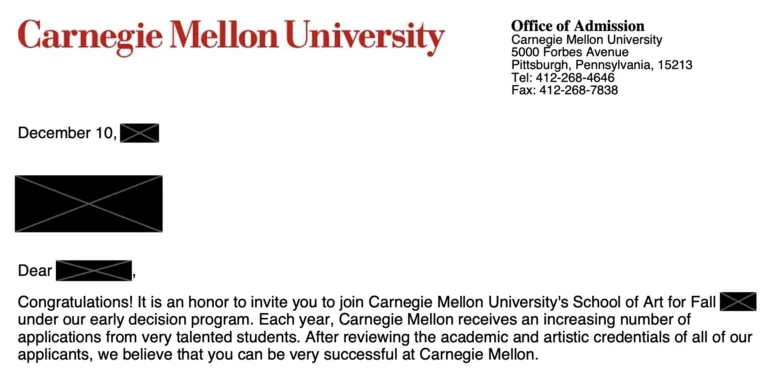
It read simply, “Hey Hoon, I got admitted Early Decision to Carnegie Mellon. Thx.”
There was no dramatic speech, just relief, and gratitude in his words.
For me, it’s these quiet satisfactions that come from watching a student commit their time, a year or more of disciplined growth, and seeing it recognized and awarded with acceptance letters. Mel had done the work, piece by piece, and the result reflected that.
* Name has been changed to protect the student’s privacy
Excerpt from Mel's Acceptance Letter: